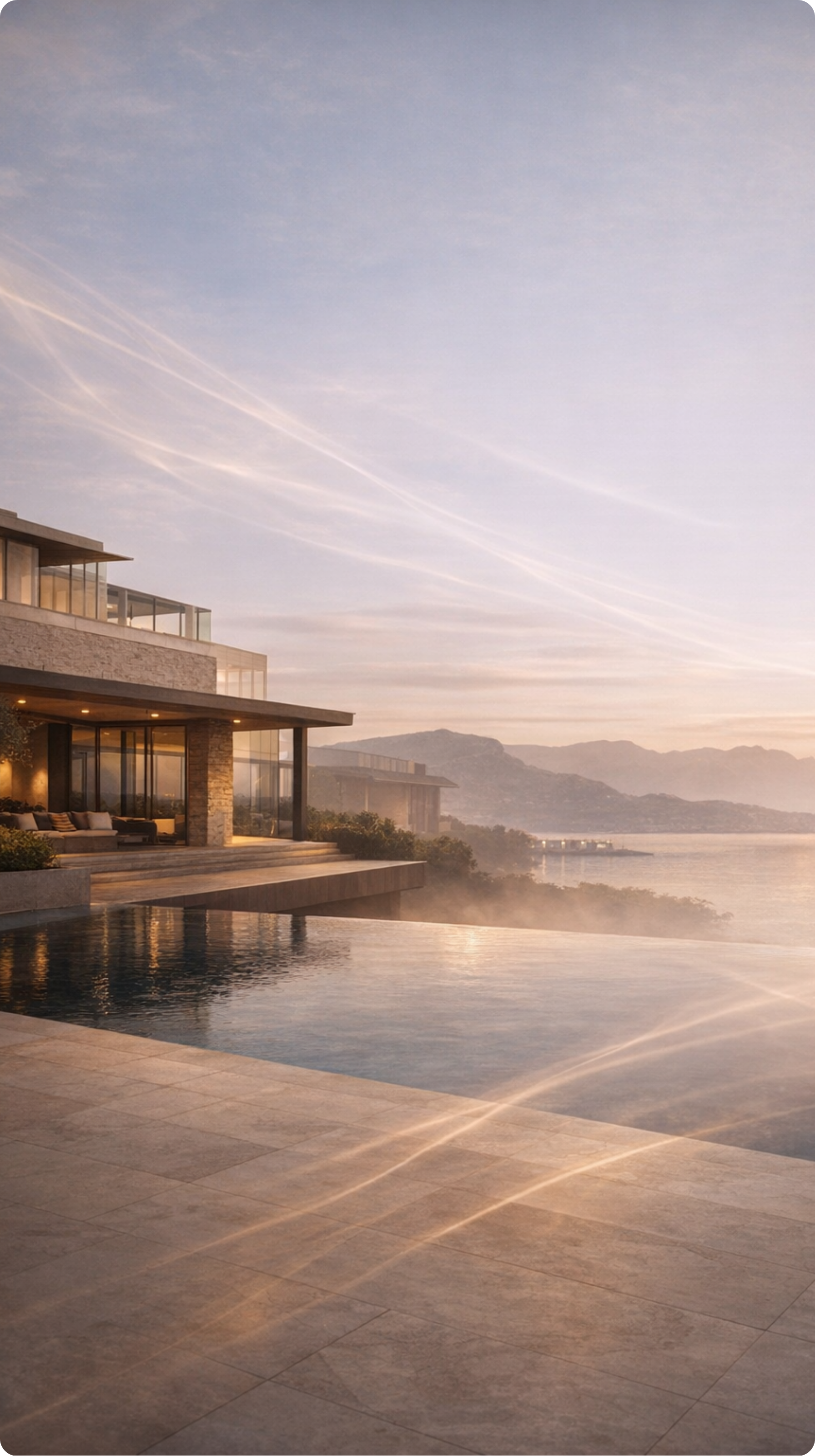
The structural forces reshaping luxury hospitality between now and 2030
For decades, competitive advantage was built through design, service excellence, location, and increasingly refined wellness amenities. Experiences became richer, spas more advanced, and personalization more sophisticated.
Across global hotel portfolios, however, a new realization is emerging: many of the challenges now shaping guest satisfaction, staff wellbeing, and brand resilience cannot be solved by adding more experiences alone.
Between now and 2030, luxury hospitality will be shaped less by what is offered — and more by how environments themselves support people over time.
- rising expectations around sleep quality, recovery, and mental balance
- increasing staff fatigue, burnout, and retention challenges
- ESG commitments that extend beyond environmental metrics into human sustainability
- growing technological density in buildings, rooms, and infrastructure
- the complexity of delivering consistent wellbeing across large portfolios
Wellness is no longer limited to moments or locations within a hotel. It is increasingly understood as a continuous condition that guests and staff experience throughout their stay and working day, whether consciously or not.
At individual property level, experiential wellness concepts can be powerful differentiators. At portfolio level, their limits become more visible.
Treatments, amenities, and programs are designed as distinct experiences. They are entered and exited, while the surrounding environment remains constant.
As hotel environments become more technologically dense and operationally complex, invisible influences begin to matter more. These influences shape sleep quality, recovery, focus, and emotional tone without being immediately apparent.
This does not diminish the value of existing wellness concepts. It highlights that the context in which wellness takes place has become increasingly important.
Parallel to guest expectations, human sustainability has moved from a cultural aspiration to a strategic necessity.
Employee wellbeing now directly affects:- service quality
- emotional tone
- brand consistency
- and long-term operational resilience
Hotels that succeed in the next decade will not only attract guests — they will retain teams who are present, regulated, and able to deliver hospitality with authenticity.
This shift requires hospitality leaders to look beyond isolated interventions and toward conditions that support people continuously, day and night
Looking Ahead
Hospitality has always evolved by responding to what guests feel — often before they can articulate it.
Between now and 2030, the hotels that lead will be those that recognize this turning point early: that wellness, performance, and sustainability are becoming environmental qualities, not just offerings.
Understanding this shift is the first step.
How it is addressed — and how it can be approached safely at scale — is explored in the next sections of the Hospitality Framework.
Why the Next Phase of Hospitality Is Structural
The coming phase of luxury hospitality will be shaped by questions such as:
- How does an environment support rest, focus, and recovery over time?
- How can environmental stress factors be reduced without disrupting operations?
- How can wellbeing be supported consistently across dozens or hundreds of properties?
- How can hotels be future-proofed for increasing digital density without compromising human experience?
These are not questions of design or programming alone.
They are questions of infrastructure.
They require new ways of thinking about space, environment, and impact — before experiences, treatments, and services.